

Library Catalog
Latest Documents and Publications listed. Use search terms in the box below to find what you need

Somalia Gu 2025 Rainfall Performance Review Hagaa Outlook and Impacts on Livelihoods
According to the seasonal Outlook co-produced by FAO SWALIM, World Meteorological Organization (WMO), IGAD Climate Prediction and Application Centre (ICPA)C, and Government of Somalia, Gu 2025 was expected to be characterized by below normal rainfall, normal to delayed onset and above normal temperatures. There was a 45 % likelihood that most parts of the country were to observe below normal rains. There was even a higher likelihood (55 %) of drier conditions being observed over Gedo region, and some parts of Bay, Bakool, Hiraan and Awdal regions. However, there were chances of very isolated above normal rains in some parts of Puntland. There was a very low probability that cumulative Gu rainfall amount would exceed 200mm particularly over the Shabelle River Catchment. However, there were chances of an exceedance of 200 mm over the Juba River Catchment (Middle Juba and Lower Juba).
Publication Type:
Rainfall Performance
Publication Date:
Author:
Corporate Author:
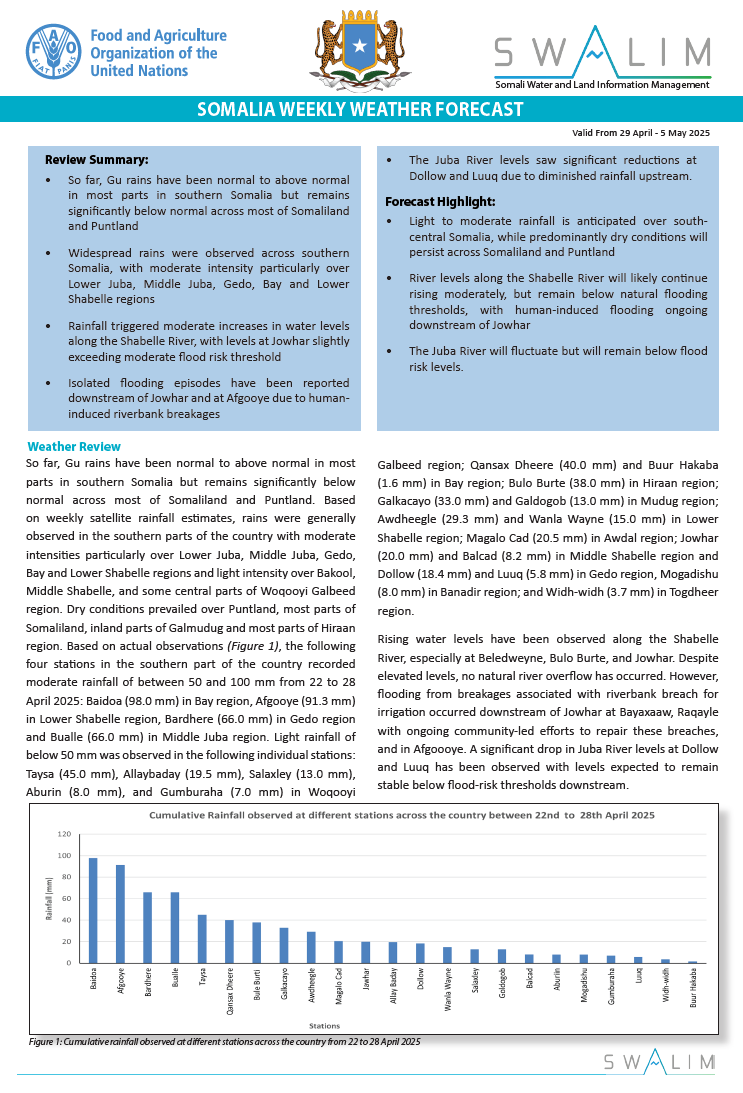
Somalia Rainfall Forecast – Issued 07 May 2025
Light to moderate rains is expected across central and southern regions this week, with intense storms possible in Middle Shabelle and Galgaduud. Dry and hot conditions persist in Puntland and Awdal, raising heat stress and water scarcity concerns. Rainfall prospects remain favorable for most of May.
Publication Type:
Rainfall Forecast
Publication Date:
Author:
Corporate Author:

Somalia Rainfall Forecast – Issued 13 May 2025
According to the NOAA-NCEP Global Forecasting System (GFS) forecast, sparse light rains are expected across the country with chances of moderate intensity over Lower Juba, Hiraan and Mudug. Dry conditions are generally likely over most parts of Puntland and Somaliland. The temporal and spatial distribution of the forecast rainfall are as follows:
Light cumulative rainfall of less than 50 mm is forecast over most parts of Banadir region; Middle Juba region particularly Jilib and Bu’aale districts; Lower Shabelle region particularly Baraawe and Marka districts; eastern parts of Ceel Waaq district in Gedo region; Qansax Dheere, central parts of Diinsoor distirct, northern parts of Buur Hakaba district and Baydhaba town in Bay region; Xudur district in Bakool region; areas bordering both Belet Wayne and Bulo Burte districts; Galagaduud region particularly Dhuursamarreeb district, western parts of Ceel Buur and north-eastern pats of Ceel Dheer districts; eastern parts of Hobyo districts in Mudug region; Togdheer region particularly Buuhodle district, western parts of Owdweyne district and northern parts of Burco district; northern parts of Caynabo district in Sool region; and Sanaag region particularly Ceerigaabo district.
Dry conditions are likely to prevail over most parts of Awdal, Woqooyi Galbeed, Nugaal, Bari and Middle Shabelle regions; Togdheer region particularly Sheikh and northern parts of Owdweyne district; Sanaag region particularly Ceel Afweyn, Laasqoray and southern parts of Ceerigaabo district; Xudun and Taleex districts in Sool region; most parts of Galdogob, Gaalkacyo, Jariiban and western parts of Hobyo district in Mudug region; Galgaduud region particularly Cabudwaaq, eastern parts of Ceel Dheer and Ceel Buur districts; Hiraan region particularly Jalalaqsi district; northern parts of Baydhaba district in Bay region; Saakow district in Middle Juba region; Gedo region particularly Doolow, Luuq, Baardheere and southern parts of Belet Xaawo district; and Afmadow district in Lower Juba region.
Publication Type:
Rainfall Forecast
Publication Date:
Author:
Corporate Author:
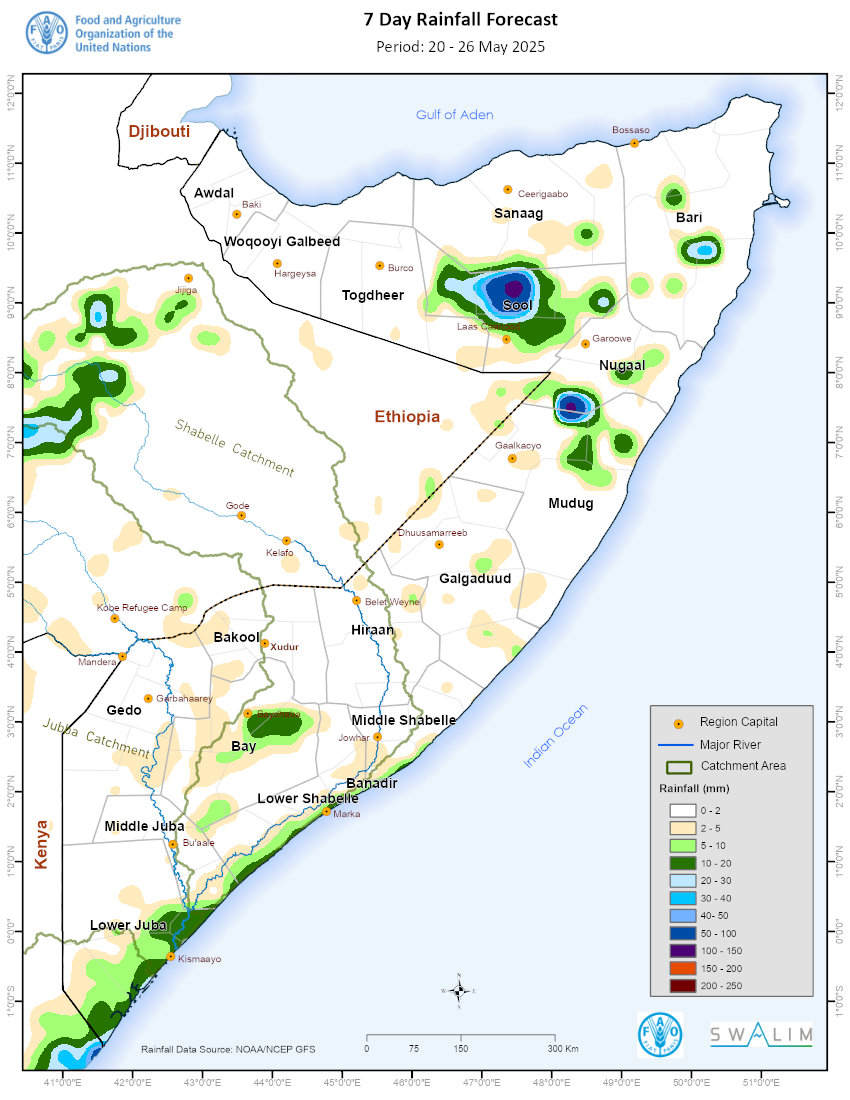
Somalia Rainfall Forecast – Issued 20 May 2025
Based on NOAA-NCEP Global Forecasting System (GFS), scanty rains are expected over some parts of the country with moderate rains expected in Sool region and areas at the border of Mudug and Nugaal regions. Dry conditions are likely to prevail over most parts of the Somaliland and south-central.
Light cumulative rainfall of less than 50 mm is forecast over most parts of Banadir region; Badhaadhe, Kismaayo and Jamaame districts in Lower Juba region; Lower Shabelle region particularly coastal parts from Baraawe, Marka and Afgooye districts; several parts of Baydhaba town and north-western parts of Buur Hakaba districts in Bay region; most parts of Xudun,Taleex, southern parts of Caynabo and northern parts of Laas Caanood districts in Sool region; central parts of Jariiban district and north-eastern parts of Gaalkacyo districts in Mudug region; central parts of Nugaal region particularly areas bordering Eyl, Garoowe and Burtinle districts; and Bari region particularly central parts of Bandarbeyla district and eastern parts of Iskushuban district.
Dry conditions are likely to prevail over most parts of Awdal, Woooyi Galbeed,Togdheer,Sanaag, Galgaduud, Hiraan, Bakool, Middle Juba, Gedo, and Middle Shabelle regions; most parts of Xarardheere, Hobyo, Galdogob, and sothern parts of Gaalkacyo districts in Mudug region;most parts of Diinsoor, Qansax Dheere, southern parts of Buur Hakaba and northern parts of Baydhaba districts in Bay region; most parts of Lower Shabelle region particularly Sablaale, Kurtunwaarey, Qoryooley, Afgooye and Wanla Weyn districts; isolated areas of Garoowe,Eyl,and Jariiban districts and northern areas of Burtinle district in Nugaal region; most parts of Qardho, Calluula, Qandala, Bossaso, southern parts of Bandarbeyla and eastern parts of Iskusuban districts in Bari region and several parts Afmadow district in Lower Juba region.
Publication Type:
Rainfall Forecast
Publication Date:
Author:
Corporate Author:

Somalia Strong Wind Advisory – Issued 23 May 2025
Forecasts from NOAA GFS indicate a strong surge in southeasterly to easterly winds along the Somali coastline, beginning Friday 23 May and persisting through Sunday 26 May. Wind speeds are expected to exceed 25 knots (12.9 m/s) over coastal waters, with localized intensification to >30 knots (15.4 m/s) especially offshore of Lower Juba, Middle Juba, Lower Shabelle, and Banadir. Strong onshore winds may also affect Hobyo (Mudug), Eyl (Nugaal), and Bosaso (Bari). These winds may induce coastal waves exceeding 2 metres, particularly along the Indian Ocean coast between Kismayo and Hobyo, creating rough marine conditions.
Publication Type:
Storm Alert
Publication Date:
Author:
Corporate Author:

Somalia Rainfall Forecast – Issued 27 May 2025
According to NOAA-NCEP Global Forecasting System (GFS), light rains are expected over some parts of Bari, Sool and Sanaag regions and the coastal parts of Lower Juba, Middel Juba, Lower Shabelle and Banadir regions. Dry conditions are likely to prevail over the rest of the country.
The temporal and spatial distribution of the forecast rainfall (Figure 1) are as follows:
Light cumulative rainfall of less than 50 mm is forecast over most parts of Banadir region; Jamaame district, and coastal parts of both Badhaadhe and Kismaayo districts in Lower Juba region, Bu’aale and Jilib districts in Middle Juba region; Baraawe ,Marka, Sablaale,Kurtunwarrey, Qoryooley and Afgooye districts in Lower Shabelle region; several parts Jowhar and Balcad districts in Middle Shabelle region; Diinsoor and Buur Hakaba district and southern parts of Baydhaba district in Bay region; northern parts of Qardho district, northern areas of both Bandarbeyla and Iskushuban districts in Bari region; border areas of Ceel Afweyn and Ceerigaabo districts and southern parts of Laasqoray in Sanaag region; north-eastern parts of Burco district and northern parts of Buhoodle district in Togdheer region; most parts of Xudun and Taleex districts, north-eastern parts of Caynabo district and Laas Caanood town in Sool region; and its border areas with Burtinle district in Nugaal region.
Dry conditions are likely to prevail over the rest of the country particularly Awdal, Woqooyi Galbeed, Nugaal, Mudug, Galgaduud, Hiraan, Bakool, and Gedo regions. Dry conditions are also likely over most parts of Togdheer region particularly Sheikh and Owdweyne districts, south and north-western parts of Burco district and southern parts of Buuhoodle district; Ceel Afweyn and Ceerigaabo districts and northern parts of Laasqoray district in Sanaag region; Bossaso, Qandala and Caluula districts, southern parts of Bandarbeyla district and central parts of Iskushuban district in Bari region; northern parts of Caynabo district and eastern parts of Laas Caanood district in Sool region; most parts of Afmadow district and inland areas of both Baadhadhe and Kismayo districts in Lower Juba region; Saakow district in Middle Juba region; most parts of Qansax Dheere district and north-western parts of Baydhaba district in Bay region; Wanla Weyn district in Lower Shabelle region; and several parts of Cadale and Adan Yabaal districts in Middle Shabelle region.
Publication Type:
Rainfall Forecast
Publication Date:
Author:
Corporate Author:
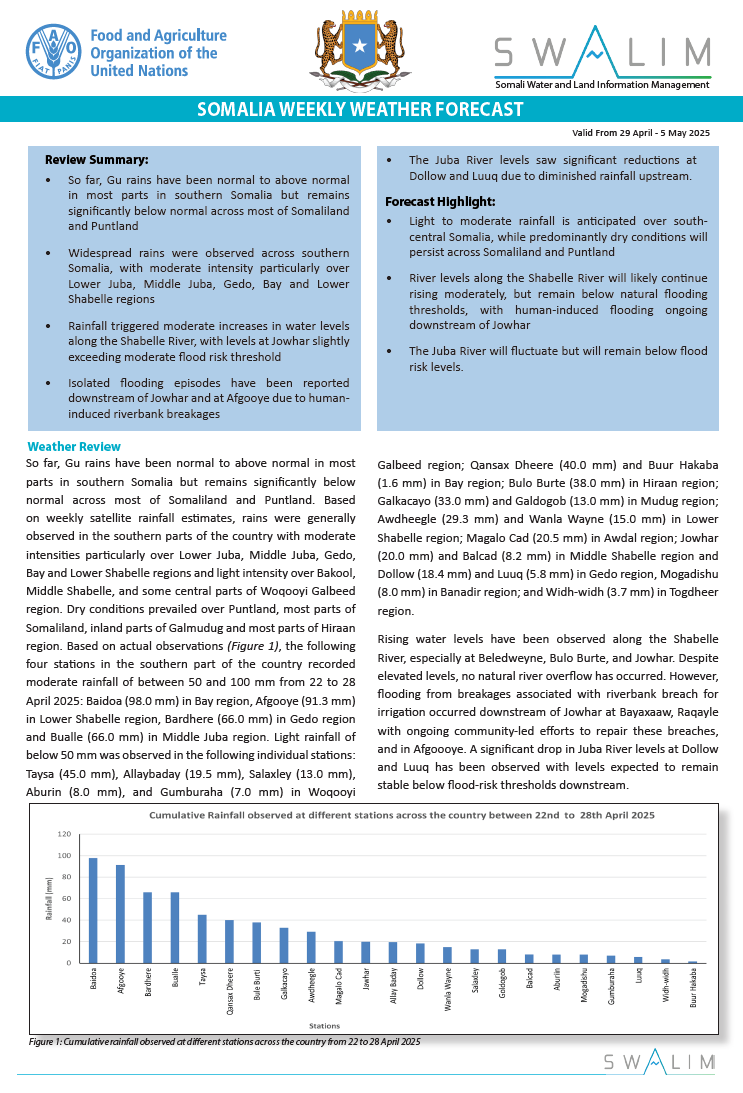
Somalia Rainfall Forecast – Issued 30 April 2025
According to the NOAA-NCEP Global Forecasting System (GFS) forecast, light to moderate rains are expected in some areas in the southern and central inland parts of the country and isolated areas in Somaliland. Dry conditions are anticipated to prevail over most areas in Puntland, Lower Juba region, and central coastal parts of the country. The temporal and spatial distribution of the forecast rainfall (Figure 1) are as follows:
Moderate cumulative rainfall of 50 mm to 100 mm is likely to occur over isolated areas in Bay region particularly eastern parts of Diinsoor district and areas in Baydhaba-Buur Hakaba border; western parts of Rab Dhuure district and southern parts of Ceel Barde district in Bakool region; central parts of Owdweyne district inTogdheer region; and northern parts of Ceerigaabo district in Sanaag region. Such moderate rains are expected to fall over the upper sections of the Juba River catchment in Ethiopia.
Light cumulative rainfall of less than 50 mm is forecast over most parts of Gedo, Middle Juba, Bay, Bakool, Lower Shabelle, Hiraan and Togdheer regions; some parts of Galgaduud region particularly the areas bordering Ceel Buur and Dhuusamareeb districts, and the eastern parts of Cadaado district; most parts of Galdogob district, areas bordering Gaalkacyo and Hobyo districts in Mudug region; parts of Awdal region particularly southern areas of both Borama and Baki districts; most parts of Sanaag region particularly Laasqoray district, eastern areas of Ceel Afweyn District, and western parts of Ceerigaabo district; most parts of Gebiley district and northern areas of Hargeisa district in Woqooyi Galbeed region; most parts of Xudun district and southern areas of Laas Caanood in Sool region; and northern parts of Qandala district in Bari region. Rains of similar intensity are likely to fall over most areas within the catchments of both Juba and Shabelle River.
Dry conditions are likely to prevail over most parts Lower Juba, Middle Shabelle and Nugaal regions; most parts of Galgaduud region particularly Ceel Dheer District and southern parts of Ceel Buur district; several parts of Mudug region particularly Xarardheere, Hobyo and Jariiban districts; most parts of Bari region particularly Bossaso, Qardho, Iskushuban ,Callula and southern areas of Qandala district; most parts of Taleex district and northern parts of Laas Caanood district in Sool region; western parts of Ceel Afweyn district and eastern parts of Ceerigaabo district in Sanaag region; Woqooyi Galbeed region particularly Berbera and Hargeisa districts; and several parts of Awdal region particularly Zeylac and Lughaye districts.
Publication Type:
Rainfall Forecast
Publication Date:
Author:
Corporate Author:
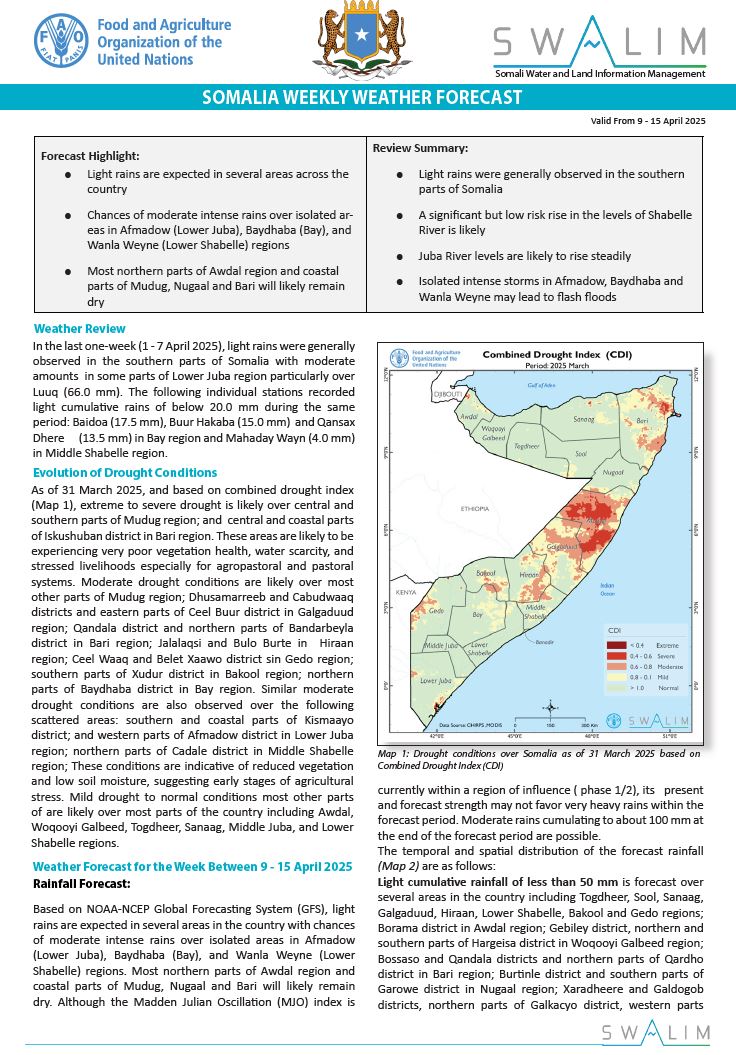
Somalia Rainfall Forecast – Issued 10 April 2025
Based on NOAA-NCEP Global Forecasting System (GFS), light rains are expected in several areas in the country with chances of moderate intense rains over isolated areas in Afmadow (Lower Juba), Baydhaba (Bay), and Wanla Weyne (Lower Shabelle) regions. Most northern parts of Awdal region and coastal parts of Mudug, Nugaal and Bari will likely remain dry. Although the Madden Julian Oscillation (MJO) index is currently within a region of influence ( phase 1/2), its present and forecast strength may not favor very heavy rains within the forecast period. Moderate rains cumulating to about 100 mm at the end of the forecast period are possible.
The temporal and spatial distribution of the forecast rainfall are as follows:
Light cumulative rainfall of less than 50 mm is forecast over several areas in the country including Togdheer, Sool, Sanaag, Galgaduud, Hiraan, Lower Shabelle, Bakool and Gedo regions; Borama district in Awdal region; Gebiley district, northern and southern parts of Hargeisa district in Woqooyi Galbeed region; Bossaso and Qandala districts and northern parts of Qardho district in Bari region; Burtinle district and southern parts of Garowe district in Nugaal region; Xaradheere and Galdogob districts, northern parts of Galkacyo district, western parts of Hobyo district in Mudug region; Jowhar and Adan Yabaal districts in Middle Shabelle region; and Qansax Dheere and northern parts of Buur Hakaba district in Bay region. It is important to note that such light rains are also likely over the upper catchments of Juba River in Ethiopia.
Moderate cumulative rainfall of 50 mm and more is likely over isolated areas in the northern parts of Afmadow district in Lower Juba region; northern parts of Baydhaba district in Bay region; central parts of Wanla Weyne district in Lower Shabelle region; Balcad district in Middle Shabelle region; northern parts of Ceel Barde district and northern parts of Tayeeglow district in Bakool region; Jalalaqsi district and central parts of Bulo Burte district in Hiraan region; northern and southern parts of Laasqoray district and eastern parts of Ceerigaabo district in Sanaag region; and central parts of Burco district in Togdheer region. Similar moderate rains will also be observed over most parts of the upper catchments of Shabelle River in Ethiopia. The rains over isolated areas in the northern parts of Afmadow district in Lower Juba region; northern parts of Baydhaba district in Bay region; central parts of Wanla Weyne district in Lower Shabelle region may increase in intensity with up to more than 50 mm within the first 3 days and summing up to more than 100 mm by the end of the forecast period.
Dry conditions are likely to prevail over most parts of Middle Juba region; Zeylac, and Lughaye districts and northern parts of Baki district in Awdal region; Berbera district, and northern parts of Gebiley district and central parts of Hargeisa district in Woqooyi Galbeed region; northern parts of Ceel Afweyn district in Sanaag region; Caluula, Iskushuban and Bandarbeyla districts and southern parts of Qardho district in Bari region; Eyl district in Nugaal region; Jariiban, Hobyo and Cadaado districts, and southern parts of Galkacyo district in Mudug region; eastern parts of both Ceel Buur district; eastern and western parts of Dhuusamarreeb district, and coastal parts of Ceel dheer district in Galgaduud region; Cadele district in Middle Shabelle region; Baraawe and Kurtunwaarey districts in Lower Shabelle region; northern parts of Dinsoor district and southern parts of Buur Hakaba district in Bay region; Luuq and Ceel Waaq districts in Gedo region; Jamaame district, eastern parts of both Afmadow and Badhaadhe districts and northern parts of Kismaayo district in Lower Juba region.
Publication Type:
Rainfall Forecast
Publication Date:
Author:
Corporate Author:
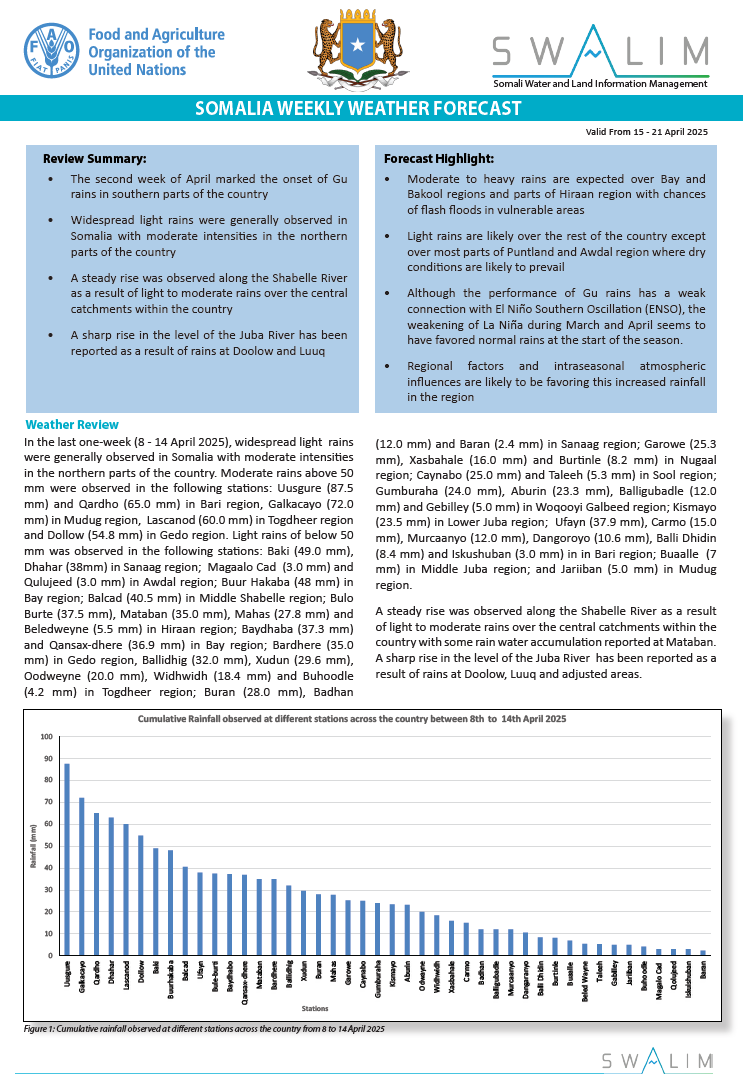
Somalia Rainfall Forecast – Issued 16 April 2025
According to the NOAA-NCEP Global Forecasting System (GFS) forecast, moderate (50 – 100 mm) to heavy rains (100 – 150 mm)are expected over Bay and Bakool regions and parts of Hiraan region. Light rains (less than 50 mm) are likely over the rest of the country except over most parts of Puntland and Awdal region where dry conditions are likely to prevail. Although the current and forecast position of Madden Julian Oscillation (MJO) index is outside the region of influence, the rains over Bay and Bakool may cumulate to more than 150 mm by the end of the forecast period. Other regional factors and intraseasonal atmospheric influences are likely to be favoring this increased onshore moisture transports and rainfall in the region. Although the performance of Gu rains has a weak connection with El nino southern Oscillation (ENSO), the weakening of La Niña during March and April seems to have favored moderate rains at the start of the season.
The temporal and spatial distribution of the forecast rainfall (Map 2) are as follows:
Light cumulative rainfall of less than 50 mm is forecast over several areas in the country including most parts of Togdheer, Sool, Galgaduud, Middle Juba and Banadir regions; southern parts of Hargeysa district in Woqooyi Galbeed region; Ceerigaabo district in Sanaag region; some isolated parts in the western parts of Qardho district in Bari region; northern parts of Garoowe district and western parts of Burtinle District in Nugaal region; Gaalkacyo, Galdogob and Xarardheere districts and southern parts of Hobyo district in Mudug region; Jalalaqsi district and northern parts of both Belet Weyne and Bulo Burte districts in Hiraan region; northern parts of both Jowhar and Adan Yabaal districts and coastal parts of both Balcad and Adan Yabaal districts in Middle Shabelle region; eastern parts of both Wanla Weyn and Afgooye districts in Lower Shabelle region; western parts of Qansax Dheere district and southern parts of Dinsoor district in Bay region; Doolow district and southern parts of Baardheere district in Gedo region; Jamaame district, northern parts of Kismaayo district and southern parts of Afmadow district in Lower Juba region.
Moderate cumulative rainfall of 50 mm to 100 mm is likely to occur over most parts of Bay region particularly Buur Hakaba district; most parts of Bakool region including Rab Dhuure and Ceel Barde districts; and most parts of Lower Shabelle region particularly Marka and Baraawe districts, southern parts of Sablaale district, and western parts of both Wanla Weyn and Afgooye districts; Luuq, Belet Xaawo and Garbahaarey districts, northern parts of both Ceel Waaq and Baardheere districts; south-eastern parts of Afmadow district; western parts of both Belet Weyne districts in Hiraan region; Middle Shabelle region particularly Cadale district, central parts of Jowhar, and inland parts of Balcad district; areas at the border of Ceel Buur and Dhuusamarreeb districts in Galgaduud region. It is important to note that similar moderate rains will also be observed over several parts of both Shabelle and Juba River catchments within the country and in Ethiopia.
Heavy cumulative rainfall of between 100 and 150 mm is likely to be observed over most parts of Baydhaba district and northern parts of Buur Hakaba district in Bay region; eastern parts of Luuq district in Gedo region; Waajid, Xudur and Tayeeglow districts in Bakool region; western parts of Bulo Burte district in Hiraan region.
Very heavy cumulative rainfall of over 150 mm is likely to be observed over some northern parts of Baydhaba district in Bay region; Xudur district and southern parts of Tayeeglow district in Bakool region. There is a chance that the rains over these areas may exceed 200 mm by the end of the forecast period. Daily forecasts suggest that much of these rains may be observed on the 18 and 19 April with likelihood of flash flooding over prone areas.
Dry conditions are likely to prevail over most parts Awdal and Bari regions; most parts of Lower Juba region particularly Badhaadhe district; Jariiban district in Mudug region, most parts of Nugaal region particularly Eyl district and eastern parts of Garoowe districts; some parts of Sanaag region particularly Ceel Afweyn district, northern parts of Laasqoray district and the coastal parts of Ceerigaabo district; and most parts of Woqooyi Galbeed region particularly Berbera and Gebiley districts and northern parts of Hargeisa district.
Publication Type:
Rainfall Forecast
Publication Date:
Author:
Corporate Author:
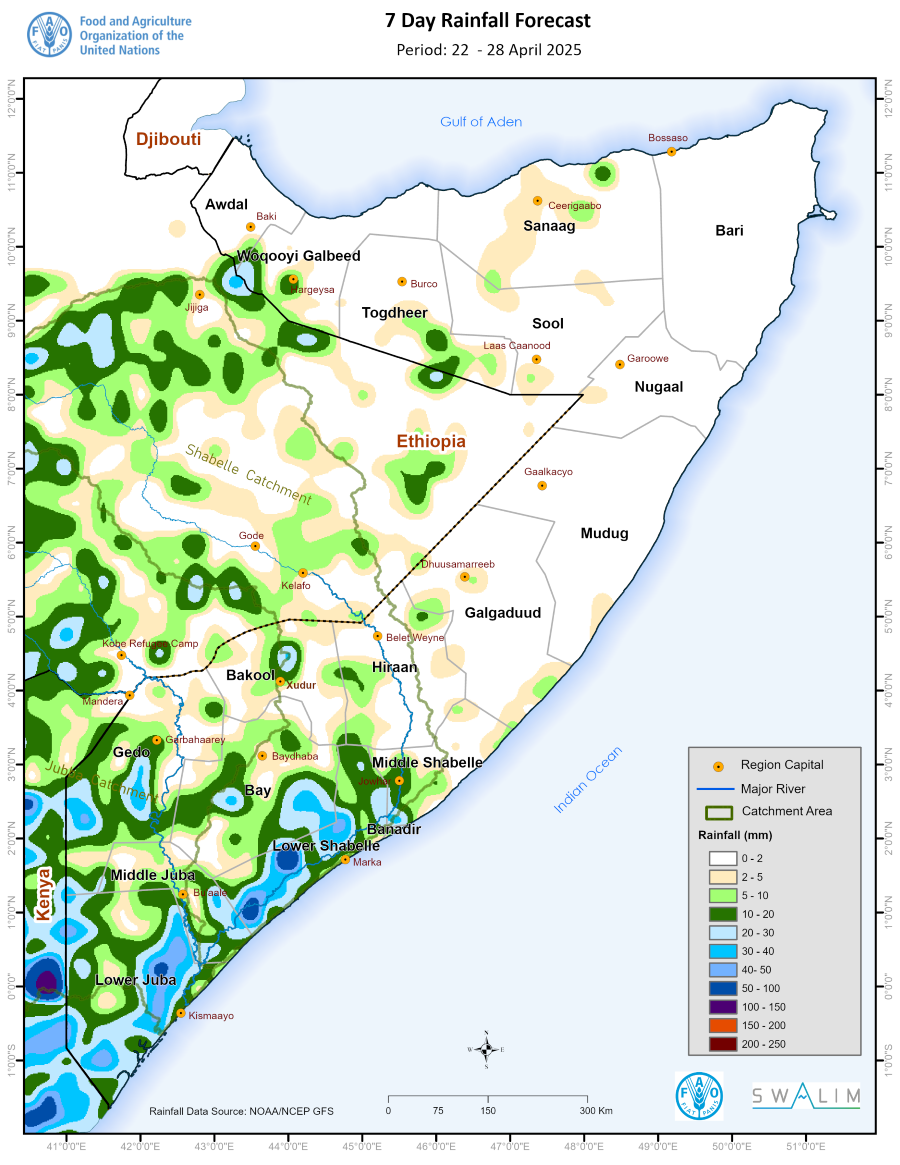
Somalia Rainfall Forecast – Issued 23 April 2025
Based on the NOAA-NCEP Global Forecasting System (GFS) forecast, light to moderate rain is expected over several areas in the southern parts of the country with dry conditions expected to prevail over Somaliland and Puntland. The temporal and spatial distribution of the forecast rainfall (Map 1) are as follows:
Light cumulative rainfall of less than 50 mm is forecast over several areas in the southern parts of the country including most parts of Lower Juba, Middle Juba, Bay, and Lower Shabelle regions; some parts of Gedo particularly Ceel Waaq and Bardheere districts; parts of Middle Shabelle region particularly Jowhar and Balcad districts; parts of Bakool region particularly Xudur and Ceel Barde districts; western parts of Belet Weyne district in Hiraan region; southern parts of Gebiley district and Hargeisa town in Woqooyi Galbeed region; Buuhoodle district and southern parts of Burco district in Togdheer region; northern coastal parts of Laasqoray district in Sanaag region. It is important to note that such rains are likely to fall over the Juba River catchment within and outside the country. While the rains over the upper and central catchment of the Shabelle River will be very light, they may increase in intensity over the lower sections in Middle Shabelle including Jowhar.
Moderate cumulative rainfall of 50 mm to 100 mm is likely to occur over isolated areas in Lower Juba region particularly southern parts of Afmadow district; and areas bordering Sablaale and Baraawe districts and northern border areas of Kurtunwarey and Qoryooley districts in Lower Shabelle region. It is important to note that intense but isolated rains of above 100 mm may be observed over areas in Lower Juba bordering Kenya.
Dry conditions are likely to prevail over most parts Awdal, Woqooyi Galbeed, Togdheer, Sanaag, Sool, Bari, Nugaal, Mudug and Galgaduud regions; most parts of Hiraan region particularly Bulo Burte and Jalaqsi districts and eastern parts of Belet Weyne; eastern parts of Middle Shabelle region particularly Adan Yabaal district and the northern parts of Cadale district; and some parts of Bakool region particularly Waajid, Rab Dhuure and Tayeeglow districts.
Publication Type:
Rainfall Forecast
Publication Date:
Author:
Corporate Author:
Pages
 RSS feed [compliant with the Agris AP] |
  Agris AP XML