

Library Catalog
Latest Documents and Publications listed. Use search terms in the box below to find what you need
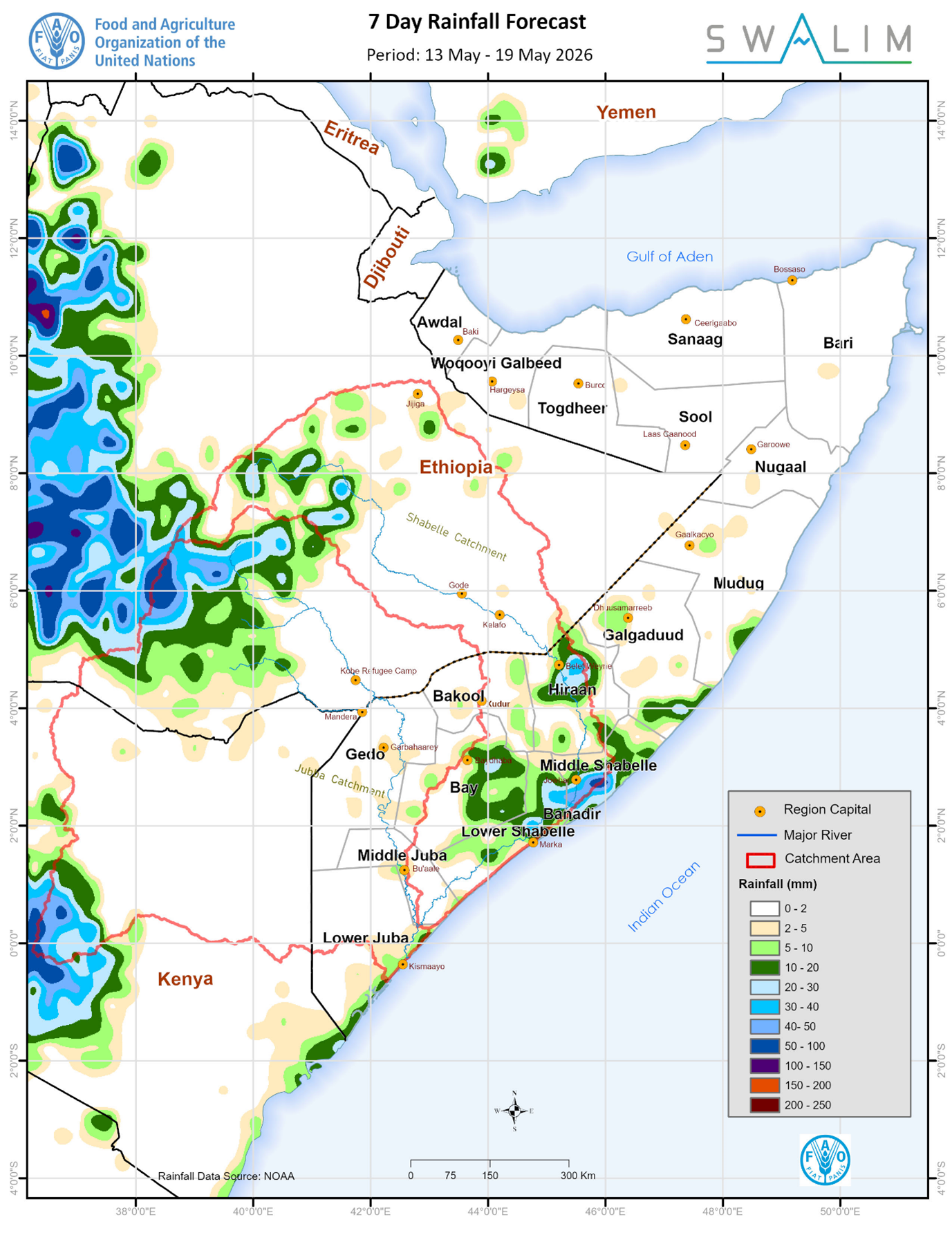
Somalia Rainfall Forecast – Issued 13 May 2026
According to the NOAA-NCEP GFS rainfall forecast, rainfall during 13–19 May 2026 is expected to be mostly light and localized across Somalia (Figure 4).
Light rainfall below 50 mm is likely over localized parts of the Shabelle basin, including sections around Belet Weyne and Jalalaqsi districts in Hiraan region; Jowhar and Balcad districts in Middle Shabelle; Banadir region including Mogadishu; Wanla Weyn, Afgooye, Marka and Qoryooley districts in Lower Shabelle region; Buur Hakaba and Baidoa districts in Bay region; Tayeeglow district in Bakool region; coastal parts of Badhaadhe, Kismaayo, Jamaame and Jilib districts in Lower Juba region; central parts of Dhuusamarreeb district and coastal parts of Ceel Dheer district in Galgaduud; central parts of Galkacyo district and coastal parts of Hobyo district in Mudug region.
Dry or near-dry conditions are expected over large parts of Awdal, Woqooyi Galbeed, Togdheer, Sool, Sanaag, Bari, Nugaal, Bakool, Gedo, and Middle Juba regions; inland parts of Lower Juba region particularly Afmadow district; Dinsoor and Qansax Dheere districts in Bay region; Sablaale and Kurtunwaarey districts in Lower Shabelle region; Bulo Burte district in Hiraan region; and most inland parts of both Galgaduud and Mudug regions.
The MJO forecast initialized on 11 May 2026 shows the convective signal moving away from the most favourable western Indian Ocean phases during the early part of the forecast period supporting the forecast light localized rainfall
Publication Type:
Rainfall Forecast
Publication Date:
Author:
Corporate Author:
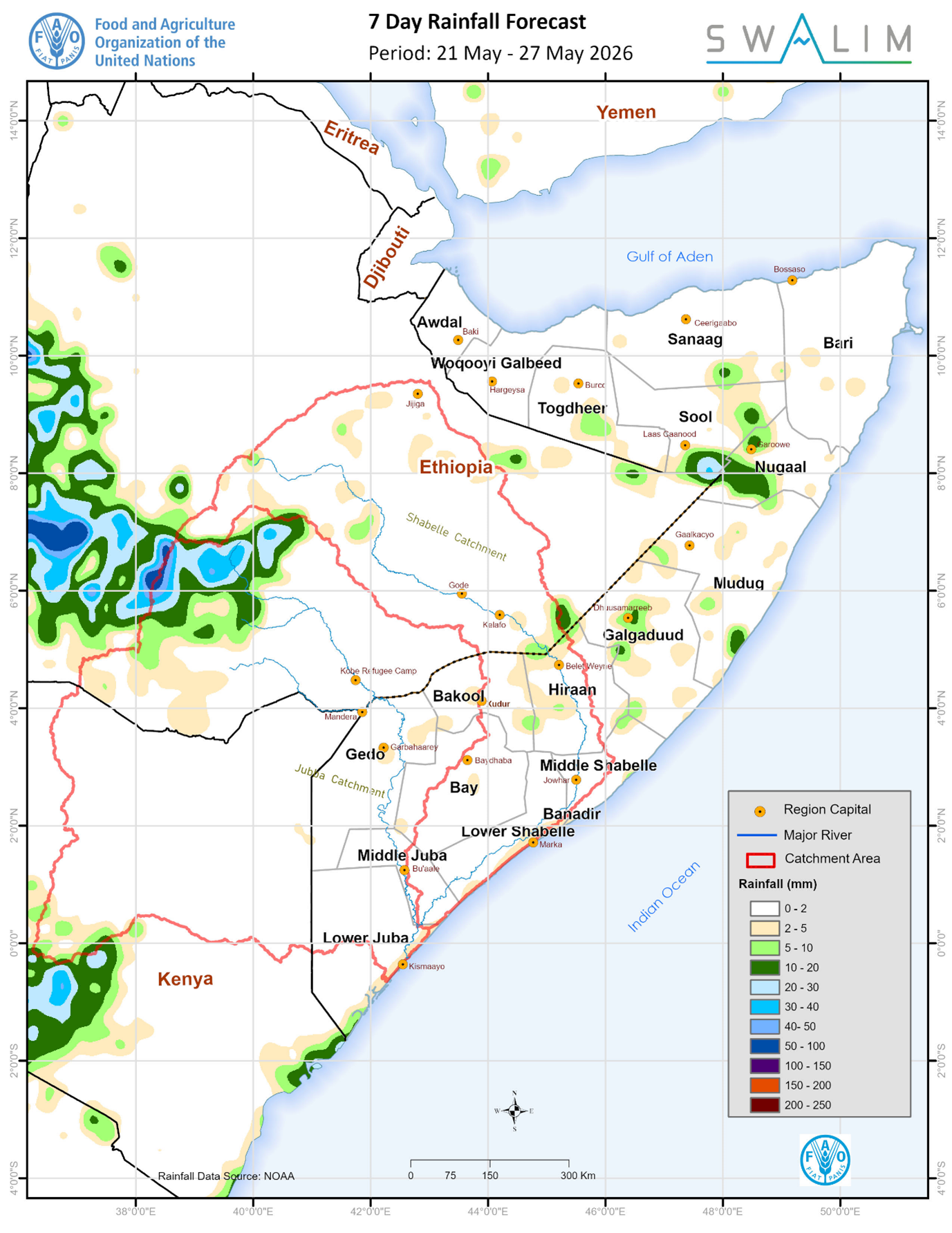
Somalia Rainfall Forecast – Issued 21 May 2026
The rainfall forecast for 21–27 May 2026 indicates mostly dry to
light localized rainfall across Somalia (Figure 5). Most areas are
expected to receive minimal rainfall, with localized light rainfall
pockets generally below 30 mm over parts of Sool, Nugaal, Bari,
Mudug, Galgaduud, sections of the Hiraan/Shabelle corridor,
and small isolated areas along the southern coastal belt.
The upstream Ethiopian catchments of the Juba and Shabelle
rivers are also not showing a strong rainfall signal likely to
generate major runoff into Somalia during the forecast week.
This means that the current Shabelle flood sensitivity should
mainly be linked to antecedent Gu rainfall, elevated river levels,
lagged upstream runoff and weak riverbank conditions, rather
than new heavy rainfall forecast for 21–27 May. The rainfall
outlook therefore suggests limited additional contribution to
river recharge during the week, although isolated showers may
still support localized pasture regeneration and surface-water
replenishment in some northern, central and riverine areas.
Publication Type:
Rainfall Forecast
Publication Date:
Author:
Corporate Author:
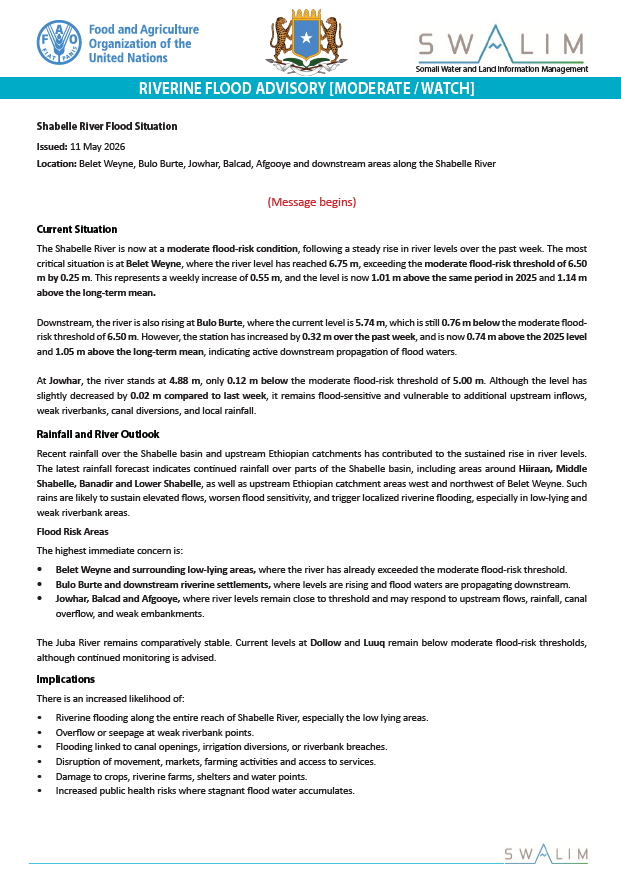
Shabelle Riverine Flood Advisory - Issued 11 May 2026
The Shabelle River is now at a moderate flood-risk condition, following a steady rise in river levels over the past week. The most critical situation is at Belet Weyne, where the river level has reached 6.75 m, exceeding the moderate flood-risk threshold of 6.50 m by 0.25 m. This represents a weekly increase of 0.55 m, and the level is now 1.01 m above the same period in 2025 and 1.14 m above the long-term mean.
Downstream, the river is also rising at Bulo Burte, where the current level is 5.74 m, which is still 0.76 m below the moderate flood-risk threshold of 6.50 m. However, the station has increased by 0.32 m over the past week, and is now 0.74 m above the 2025 level and 1.05 m above the long-term mean, indicating active downstream propagation of flood waters.
At Jowhar, the river stands at 4.88 m, only 0.12 m below the moderate flood-risk threshold of 5.00 m. Although the level has slightly decreased by 0.02 m compared to last week, it remains flood-sensitive and vulnerable to additional upstream inflows, weak riverbanks, canal diversions, and local rainfall.
Publication Type:
Flood Alert
Publication Date:
Author:
Corporate Author:
Somalia Rainfall Forecast – Issued 05 May 2026
Over the coming week, light to moderate rainfall is expected across much of Somalia, with moderate totals of 50–100 mm mainly over parts of the Shabelle basin, coastal southern Somalia, and localized areas of Sool, Nugaal, Sanaag, and Mudug, though dry pockets receiving less than 1 mm are likely in parts of Awdal, Woqooyi Galbeed, Togdheer, Bari, Bakool, Gedo, and the Jubas. No widespread heavy rainfall is forecast; however, rainfall over the Shabelle catchment and upstream Ethiopia may sustain already elevated river levels from Belet Weyne to Jowhar and beyond. Maximum temperatures will range between 30–40°C across most areas, with above-40°C heat confined to localized parts of northern Iskushuban and southern Qandala in Bari. While recent and forecast rains may support localized recovery, uneven distribution, elevated Shabelle flood risk, and lagging livelihoods mean that both drought impacts and riverine flood risk will persist.
Publication Type:
Rainfall Forecast
Publication Date:
Author:
Corporate Author:
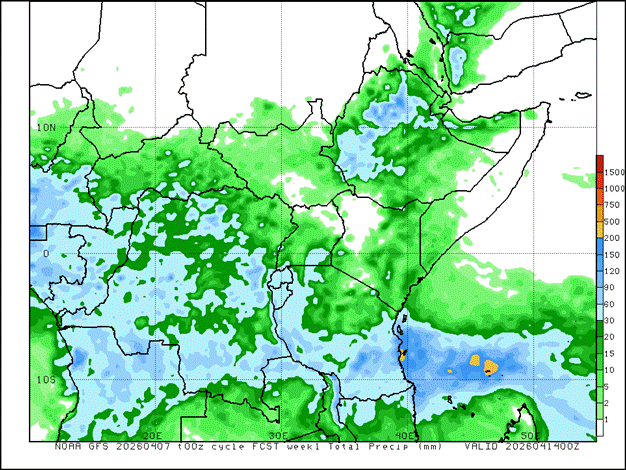
Somalia Rainfall Forecast – Issued 8 April 2026
According to NOAA-NCEP GFS, light rainfall is expected over most parts of Awdal, Woqooyi Galbeed, Sanaag, Togdheer, Lower Juba, Middle Juba, and Gedo regions. Light rains are also likely over some parts of Bay region particularly Qansax Dheere and Dinsoor districts; some parts of Bakool region particularly Rab Dhuure and Waajid districts; and some parts of Lower Shabelle particularly Sablaale and Baraawe districts. The rains over Borama district, southern parts of Baki district in Awdal region; northern parts of both Gebilley and Hargeisa districts in Woqooyi Galbeed region and northern highlands in Sanaag region may cumulate to over 50 mm by the end of the forecast week.
Publication Type:
Rainfall Forecast
Publication Date:
Author:
Corporate Author:
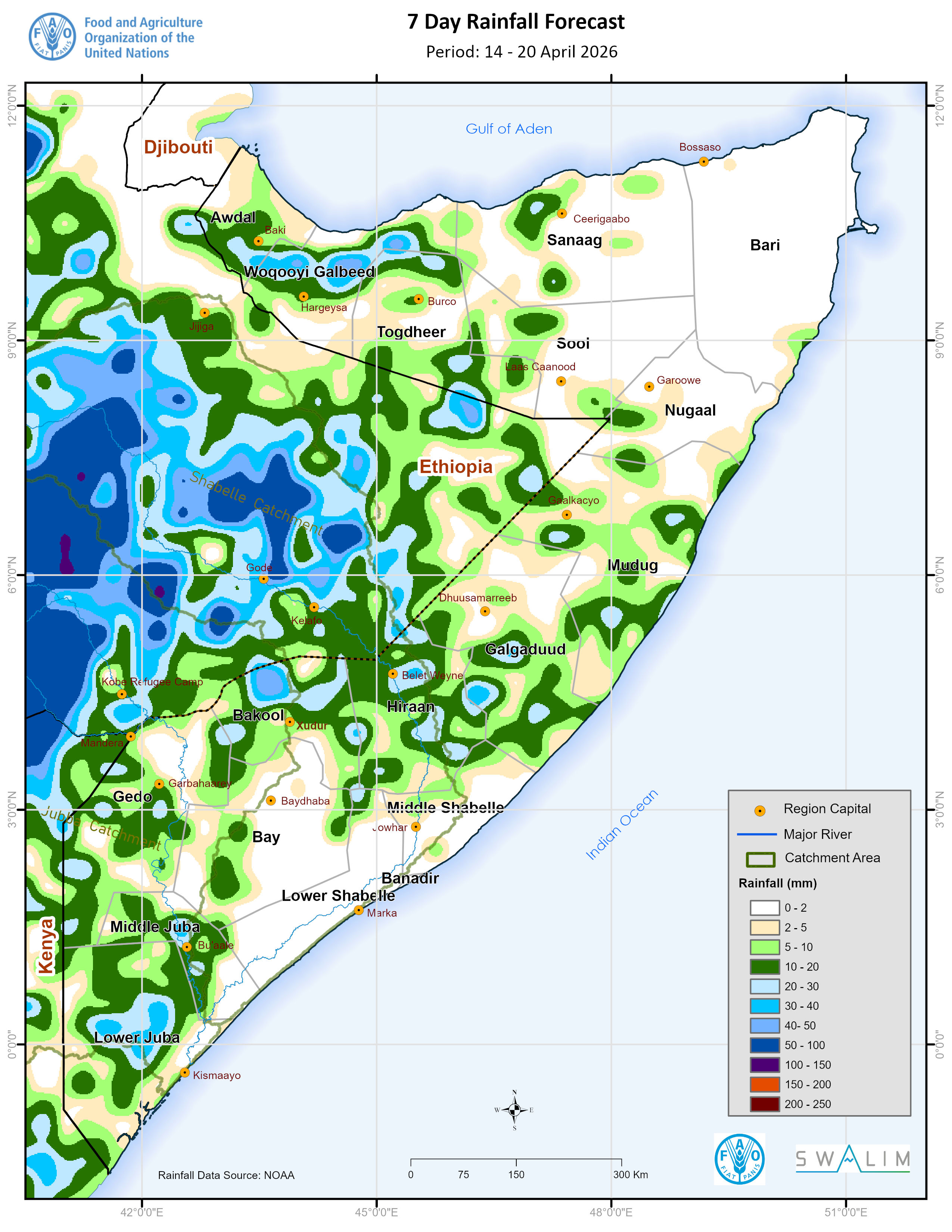
Somalia Rainfall Forecast – Issued 14 April 2026
Light to moderate rain is expected over parts of northern Somalia (Awdal, Woqooyi Galbeed, Sanaag, Togdheer) and localized areas in the south (Gedo, Lower and Middle Juba), while dry conditions dominate central and southern regions
High temperatures (35–40°C) will persist across much of central and southern Somalia, increasing evapotranspiration and moisture stress
Shabelle River levels remain elevated and propagating downstream, posing a risk of localized flooding if additional upstream and local rainfall occurs
Rainfall is expected to result in localized improvements, but recovery will remain uneven, particularly in southern drought-affected areas
Publication Type:
Rainfall Forecast
Publication Date:
Author:
Corporate Author:
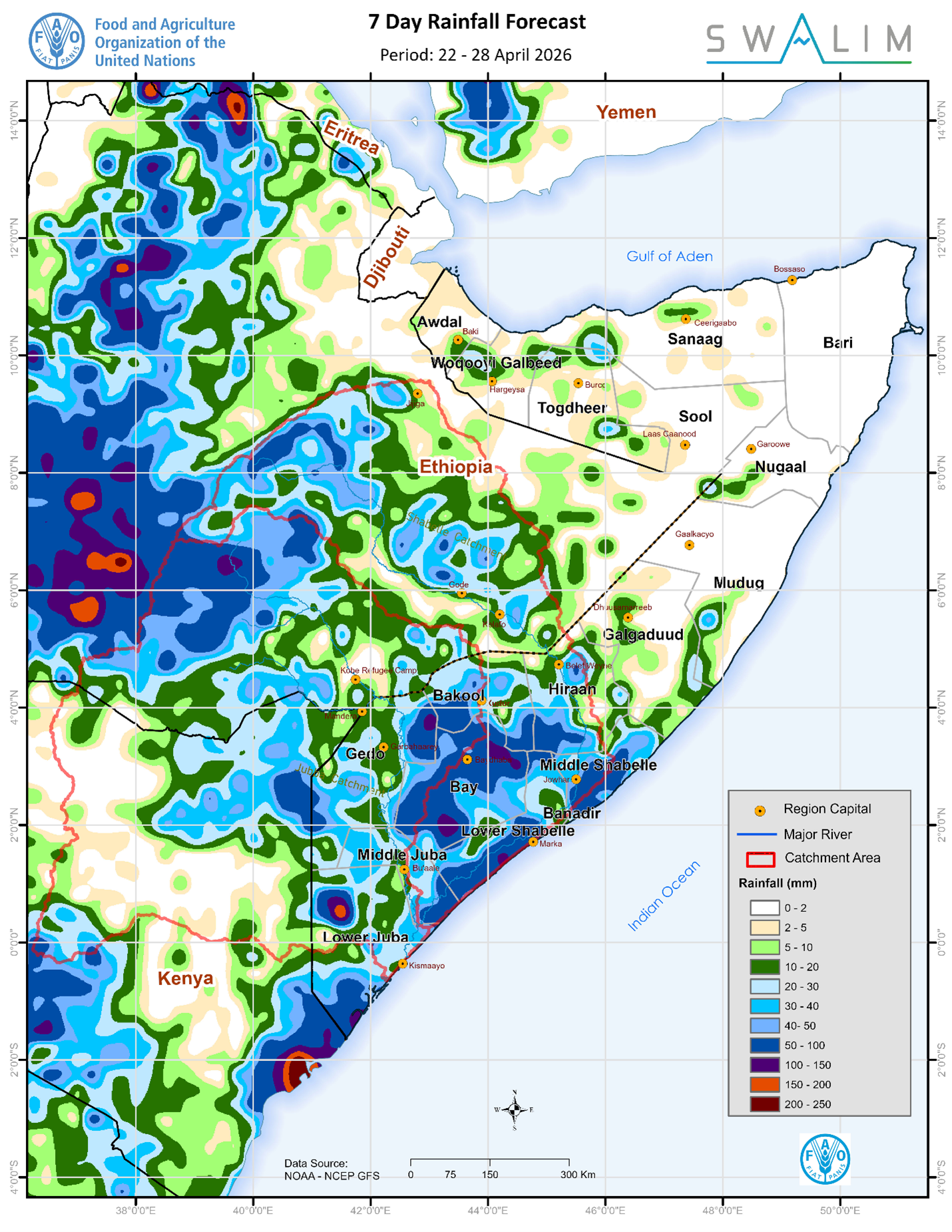
Somalia Rainfall Forecast – Issued 23 April 2026
Rainfall remains uneven, concentrated in southern districts (Lower Juba, Bay, and Gedo regions) and northern regions remain mostly dry during the coming week., very heavy rainfall is highly localized in Lower Juba with flash flooding risk in prone areas, high temperatures persist across central and southern Somalia with drought recovery expected to still be slow, localized, and uncertain, Shabelle River remains critically elevated, with flood risk downstream
Publication Type:
Rainfall Forecast
Publication Date:
Author:
Corporate Author:
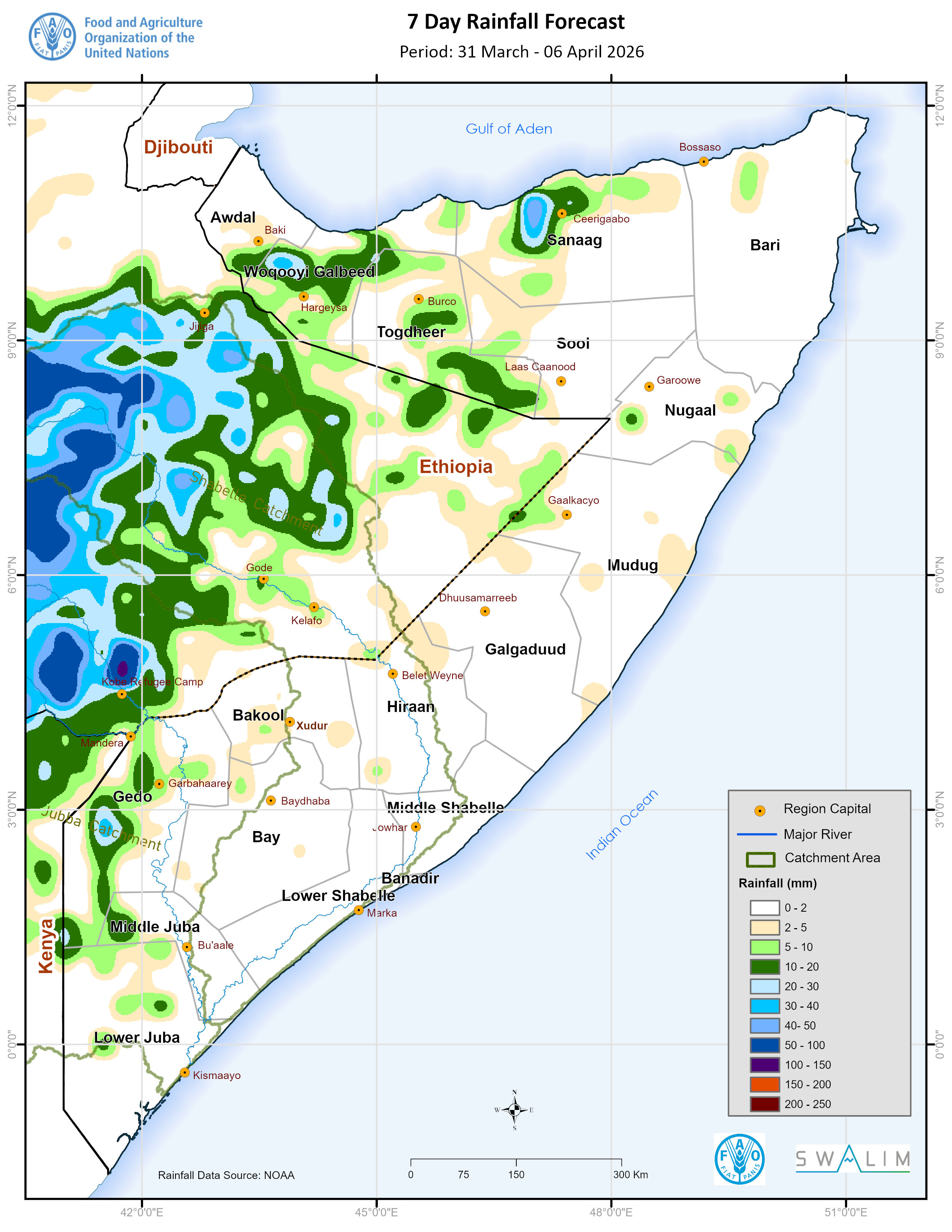
Somalia Rainfall Forecast – Issued 31 March 2026
Light rainfall is expected over parts of Gedo, Awdal, Waqooyi Galbeed, and northern Sanaag. The April outlook favors above-normal rainfall over much of southern and central Somalia. Very high temperatures (35–40°C) are expected across much of central and southern Somalia. Shabelle and Juba River levels are expected to remain below flood risk thresholds over the forecast period
Publication Type:
Rainfall Forecast
Publication Date:
Author:
Corporate Author:
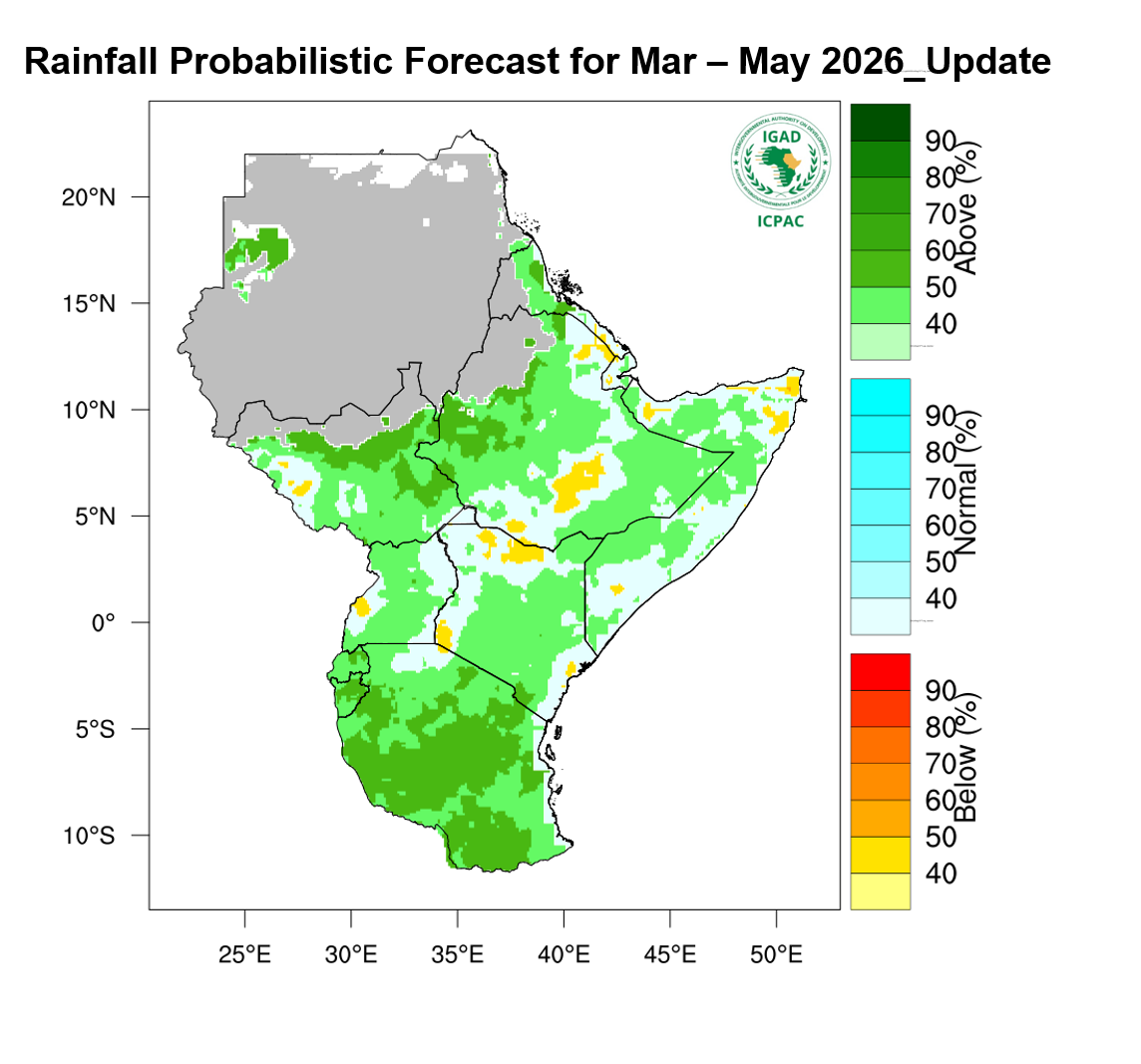
Somalia GU 2026 Seasonal Climate Outlook Update - Issued 03 March 2026
This is an update to the Gu 2026 Climate Outlook Bulletin issued on 7 February 2026. It incorporates National Climate Outlook Forum (NCOF) outcomes, latest IGAD Climate Prediction and Application Centre (ICPAC) rainfall forecast, Post Deyr IPC Analyses released on 24 February 2026, and community feedback received in mid-February 2026
Updated outlook indicates improved rainfall prospects in parts of southern, central and northern Somalia, but localized below-normal risks persist in Bari and parts of Bay and Woqooyi Galbeed, with high spatial variability
Above-normal temperatures are forecast across most of the country; however, normal to below-normal temperatures are expected over Gebiley district and southern Hargeisa (Woqooyi Galbeed), parts of Owdweyne (Togdheer), and central highland areas of Ceerigaabo (Sanaag). While heat will intensify drought impacts nationally, these localized cooler conditions may moderate evapotranspiration and slightly ease drought stress in those highland areas
Recent food security analyses signal a marked deterioration in household conditions during Feb–Mar 2026, reflecting cumulative drought impacts, water shortages, livestock losses, and weakened coping capacity
Even under a near-average Gu scenario (Apr–Jun), only partial improvement is anticipated, indicating that rainfall gains may not translate into significant recovery
Gu 2026 should therefore be treated as a stabilization window—not a recovery season, requiring sustained drought response, flexible anticipatory action, and close monitoring
Publication Type:
Rainfall Outlook
Publication Date:
Author:
Corporate Author:
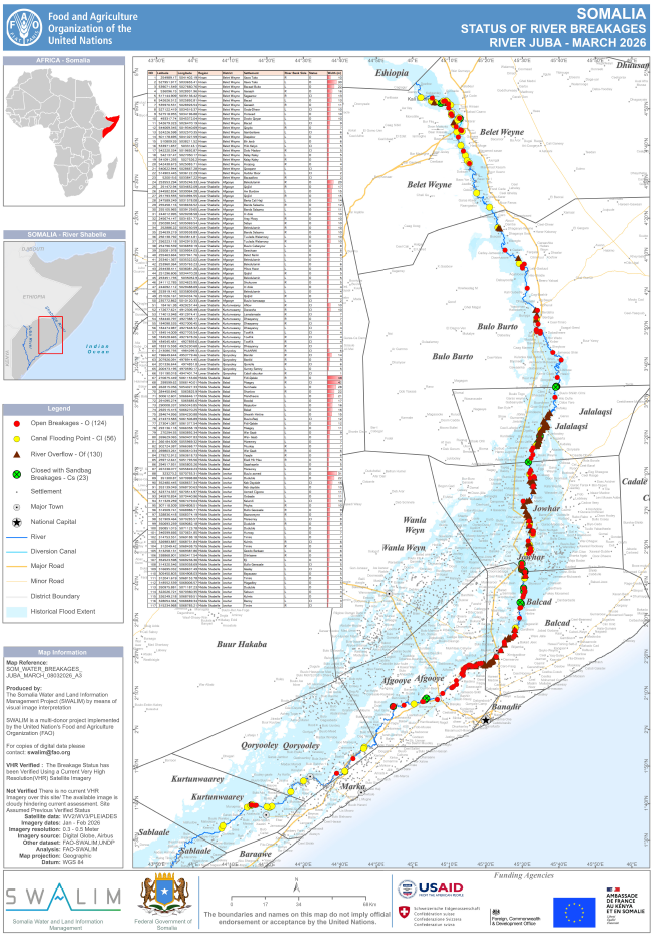
Status of River Breakages Along Juba and Shabelle Rivers - Issued March 25 2026
The Food and Agriculture Organization's Somalia Water and Land Information Management (FAO SWALIM) Project has finalized the analysis and mapping of the river breakages along the Juba and Shabelle rivers using very high resolution satellite imagery. Breakages identified in the maps have been classified into five categories: Open, Overflow, Canal Breakage, Canal Intake Flooding, and Closed with Sandbags. A legend/key for further explanation of the different types of breakages is provided. Along the Shabelle River, a total of 124 Open points, 56 Canal Flooding points, 130 River Overflow points, and 23 points Closed with Sandbags have been identified, while along the Juba River, 73 Open points, 11 Canal Flooding points, 11 River Overflow points, and 1 point Closed with Sandbags have been identified. Several other points, which are either potential or temporarily closed with sandbags, have also been identified. There is a need to close the open points and reinforce areas where there are weak river embankments to avoid loss of lives and livelihoods during the upcoming rainy season.
Publication Type:
Map
Publication Date:
Author:
Corporate Author:
Pages
 RSS feed [compliant with the Agris AP] |
  Agris AP XML