

From Early Warning to Early Action: Empowering National and State Institutions to Strengthen Flood Resilience in Somalia
Across Somalia, recurrent flooding continues to undermine food security, displace families, and erode development gains, particularly in riverine and low-lying areas. While floods are a recurring hazard, their impacts are increasingly predictable. Building resilience therefore depends not only on forecasting floods, but on strengthening national systems that enable early, anticipatory action to protect lives, livelihoods, and essential services before damage occurs. This approach is central to FAO’s Country Programming Framework (CPF) for Somalia, which aligns FAO’s support with national priorities under the Somalia National Transformation Plan (NTP), including disaster risk reduction, climate resilience, food security, and social protection. By investing in nationally owned early warning and decision-support mechanisms, FAO supports a shift from repeated emergency response toward proactive risk management.
Through SWALIM, FAO is advancing impact-based, people-centered early warning systems that translate climate and hydrological forecasts into early action. By linking hazard Information with data on exposure and vulnerability, this approach moves beyond warning that floods may occur to identifying who and what is likely to be affected, where and when. This enables institutions to prioritize anticipatory measures, strengthens shock-responsive social protection, and contributes to national data ecosystems that reduce reliance on ad-hoc emergency assessments. In doing so, It supports progress toward the Sustainable Development Goals (SDGs 1, 2, 11 and 13) and delivers on FAO’s Four Betters by protecting livelihoods, reducing disaster losses, and strengthening resilient, data-driven institutions.
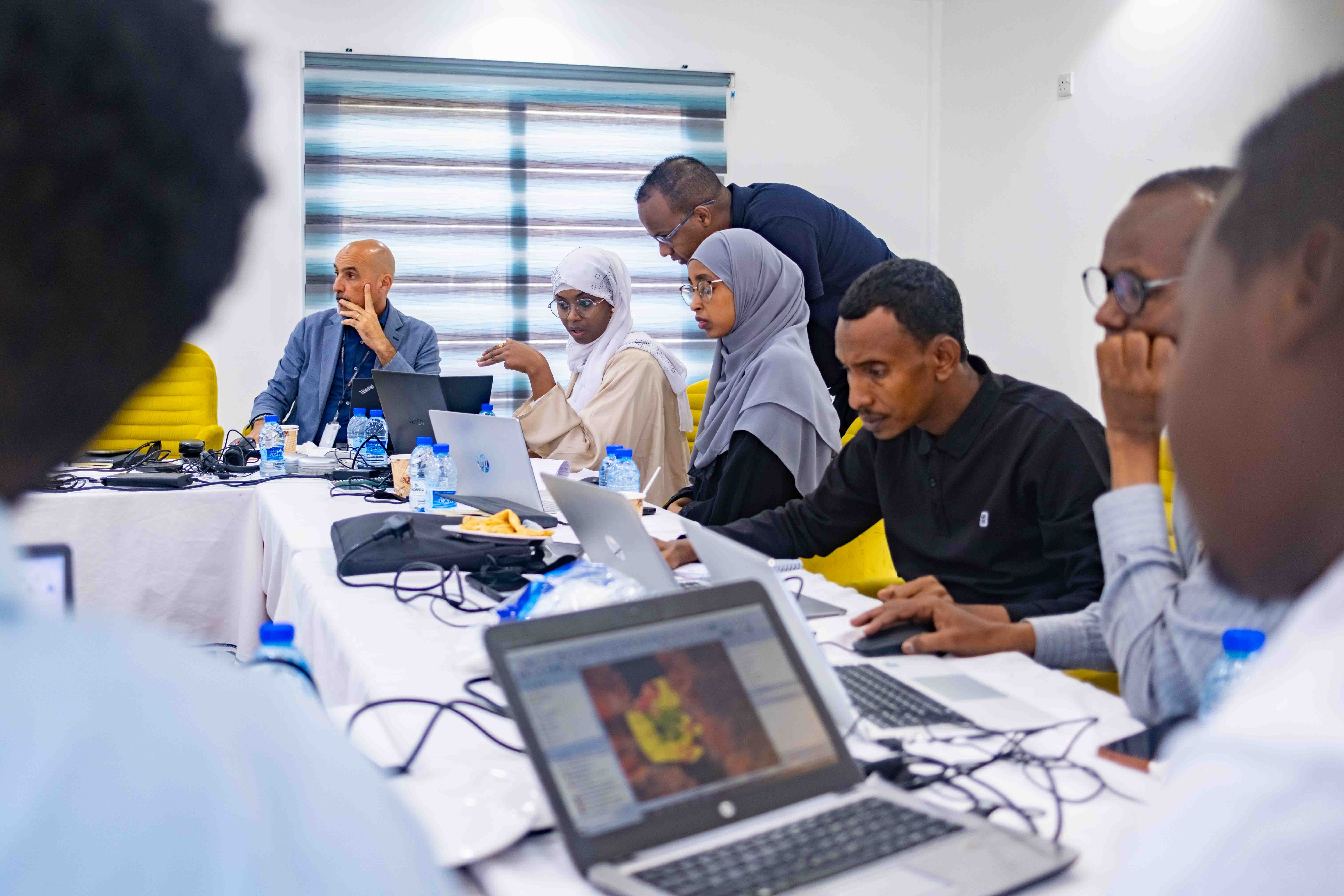
To operationalize this vision, a national training on Impact-Based Flood Forecasting and Anticipatory Action (IbF-AA) using GIS and Remote Sensing was conducted by the SWALIM Geospatial team in Mogadishu from 11 to 15 January 2026. The training brought together 22 technical staff from key Somali institutions at both federal and federal member state levels, including ministries responsible for water, environment, agriculture, livestock, planning, disaster management, and national statistics. Line ministries responsible for water, energy, and agriculture from the Federal Member States of Jubbaland, Hirshabelle, Southwest State, and Galmudug, regions highly exposed to flood risk, also participated, reinforcing collaboration across government levels.
Rather than focusing on tools alone, the training emphasized outcomes and decision-making, demonstrating how improved data access and institutional coordination can lead to earlier and more effective action. As one participant noted, “Flood information is only useful if it helps institutions decide who is at risk and what needs to be protected first.” Participants explored how forecasts and national datasets can be combined to identify priority risk areas, safeguard crops and water points, maintain access roads, and prepare social protection responses before floods escalate.
A practical case study in Beledweyne, one of Somalia’s most flood-affected cities, illustrated the value of impact-based approaches in real-world conditions. Converting flood forecasts into estimated impacts on homes, roads, agricultural land, irrigation canals, and water infrastructure, participants demonstrated how anticipatory action can be embedded into urban preparedness and local response planning. “What is changing,” observed a participant from a Federal Member State ministry, “is our ability to use data to reduce losses instead of responding after damage has already occurred.”
Beyond individual capacity development, the initiative strengthened systems and partnerships by enhancing collaboration between federal and federal member state institutions, reinforcing the use of national platforms such as SWALIM, and supported the integration of impact-based forecasting into existing early warning, planning and coordination frameworks. By prioritizing people, institutions, and nationally led systems, FAO and SWALIM demonstrate their comparative advantage in delivering scalable, high-impact solutions that bridge humanitarian action and long-term development, helping Somalia safeguard livelihoods, protect food security, and build resilience to floods now and into the future.
English
Thumbnail Image:
Feature Article:
Yes
- Log in to post comments