

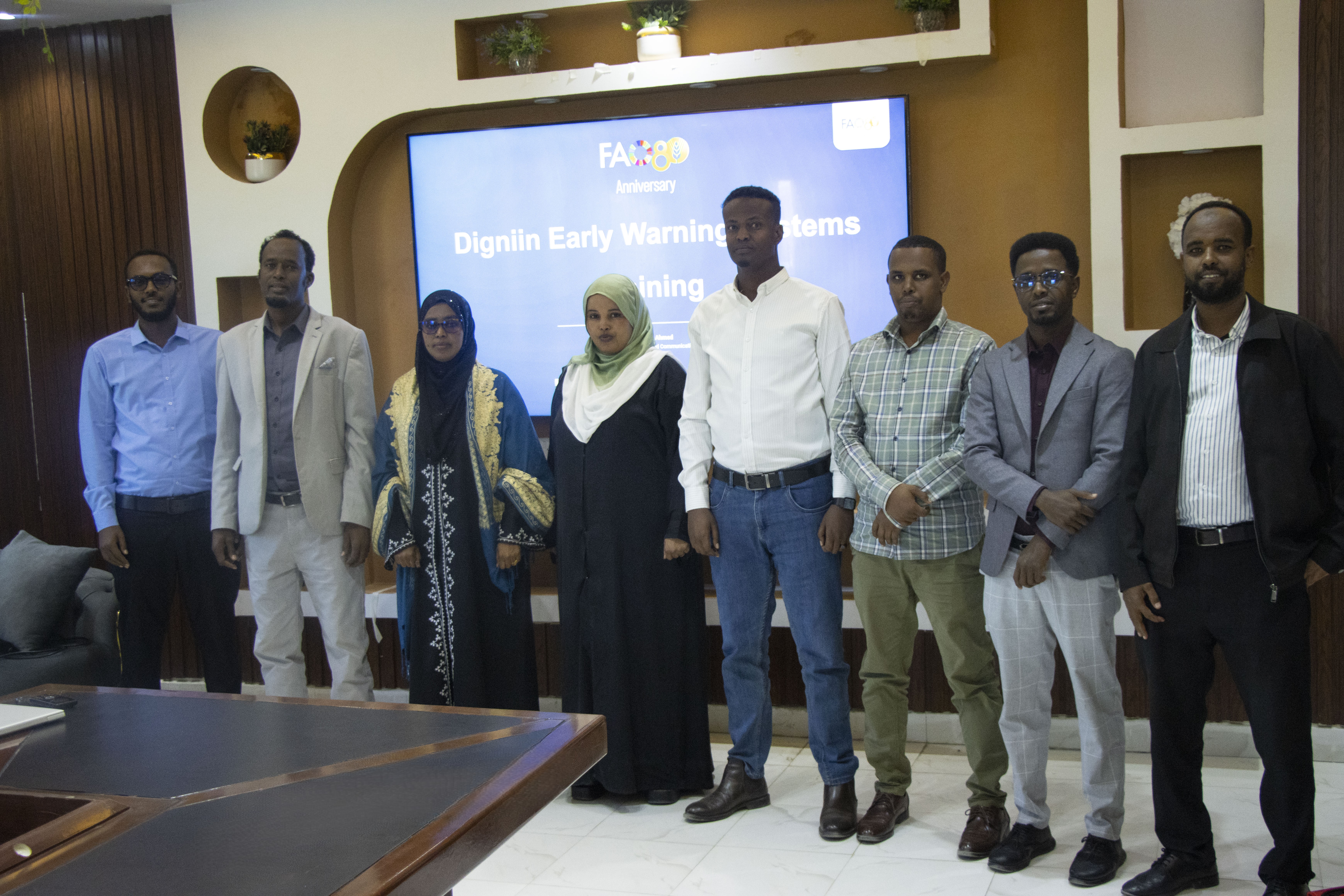
SWALIM conducted an early warning (diginin) systems training to ministry of Agriculture development in Somaliland
Across climate-vulnerable regions, timely data alone is not enough to prevent crises. The real challenge lies in ensuring that early warning information is clearly understood, trusted, and used to guide decisions. Many professionals receive climate and hazard data but lack the confidence or skills to translate it into action.
To address this challenge, a SWALIM Early Warning (Digniin) Systems Training was conducted on 14–15 January 2026 for staff from the Ministry of Agriculture Development in Somaliland. The training focused on building practical knowledge of early warning systems (EWS) and strengthening the use of SWALIM platforms to support informed planning and humanitarian decision-making.
Early warning systems are only effective when institutions understand how to interpret and apply them. Gaps in data literacy, limited familiarity with indicators such as NDVI and drought indices, and weak coordination between stakeholders can delay early action and reduce impact.
This training was designed to close that gap by strengthening foundational EWS knowledge, clarifying SWALIM’s mandate, and emphasizing the practical use of early warning products within government and humanitarian workflows.
Participants were introduced to the core early warning systems concepts, and the four pillars of EWS. The training provided an overview of SWALIM’s Early Warning System, including the key hazards monitored and the core components that support monitoring, forecasting, analysis, and dissemination.
Strong emphasis was placed on applied learning. Participants explored SWALIM data sources, rainfall monitoring networks, and seasonal forecasting methods, and gained practical skills in climate data interpretation. Hands-on sessions guided participants through reading and interpreting SWALIM bulletins and discussing how to integrate early warning information into planning and humanitarian decision-making.
By the end of the training, participants demonstrated an enhanced understanding of early warning systems, improved confidence in using SWALIM platforms and products, and clearer awareness of how EWS data supports coordinated decision-making. The training strengthened institutional capacity while also providing participants with valuable skills in climate risk analysis and evidence-based planning.
English
Thumbnail Image:
Feature Article:
Yes
- Log in to post comments