

Library Catalog
Latest Documents and Publications listed. Use search terms in the box below to find what you need
Flood Watch Bulletin 2005-11-15
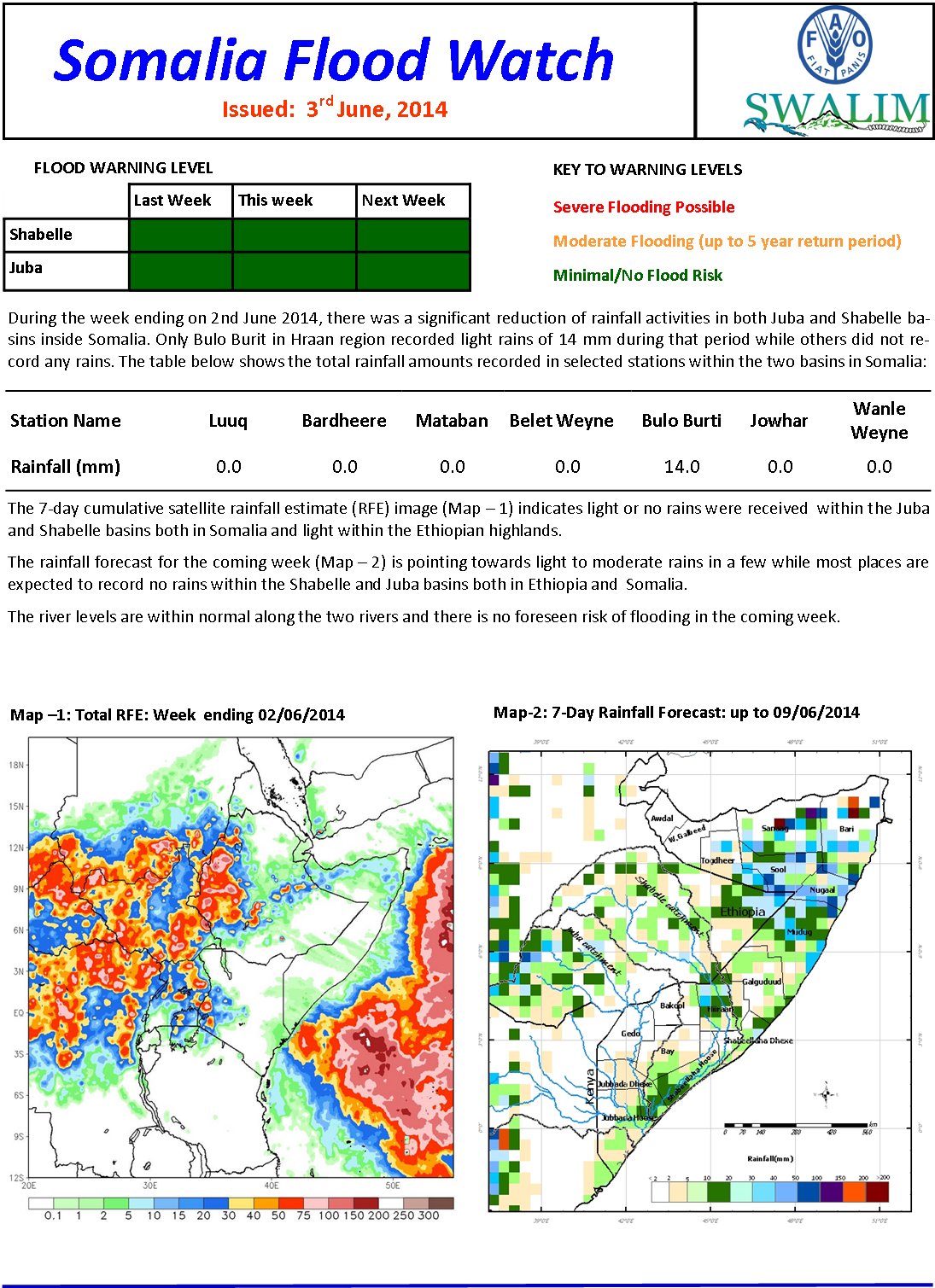
The 7-day Rainfall Estimates (RFE) for the week ending November 13th indicate low rainfall in the upper catchments of both rivers.
No rains were reported in Bulo Burti and Belet Weyne for the last week. No rain has been reported in Luuq and Bardhere. 76mm of rain fell was reported from Buale over the weekend.
The rainfall forecast for the coming week is for up to 45 mm of rain in the Ethiopian catchments and for between 10-20 mm in the Southern Somalia. Rainfall of up to 45mm is expected over North Eastern Kenya, and South Western Somalia.
Flood risk for the forecast period is considered minimal.
Publication Type:
Flood watch bulletin
Publication Date:
Author:
Corporate Author:
Publication Type:
Other
Publication Date:
Author:
Corporate Author:
German Agro Action, Somaliland
Publication Type:
Other
Publication Date:
Author:
Corporate Author:
Adventist Development and Relief Agency
FAO Project Formulation Toolkit
The Toolkit, managed by the Technical Cooperation Department (TC), is designed to facilitate the formulation of projects under the FAO supported Special Programme for Food Security (SPFS), the Technical Cooperation Programme (TCP) and TeleFood, as well as under Trust Fund arrangements. Its content is organized into five clusters: andrdquoProject Categoriesandrdquo, andrdquoFunding Sourcesandrdquo, andrdquoSPFSandrdquo, andrdquoUseful Information and Referencesandrdquoand andrdquoLessons Learnedandrdquo, each with distinct characteristics. Introductory texts to each subject provide a general context and key issues concerned, with links to further information.
Publication Type:
Other
Publication Date:
Author:
Corporate Author:
Food and Agriculture Organization of the United Nations, Rome (Italy)
River variability and complexity
River Variability and Complexity presents a new approach to the understanding of river variability. It provides examples of river variability and explains the reasons for them, including fluvial response to human activities. Understanding the mechanisms of variability is important for geomorphologists, geologists, river engineers and sedimentologists as they attempt to interpret ancient fluvial deposits or anticipate river behavior at different locations and through time. This book provides an excellent background for graduates, researchers and professionals.br � A concise new approach to the understanding of river variability, building on the author's 40 years experience of river geomorphology br � Includes helpful reference tables and charts for the study of river characteristics (type) and behaviour (dynamics) br � Includes a discussion of the unintended consequences of human actions and develops a hypothesis regarding the effect of river characteristics on human behaviour
Publication Type:
Other
Publication Date:
Author:
Schumm, S. A.
Corporate Author:
SWALIM stakeholders' Workshop Proceedings
The FAO Somalia Water and Land Information Management (SWALIM) Stakeholders Workshop was held at the Nairobi Serena hotel on 15th September 2005 and was attended by about 60 representatives from United Nations agencies, Non governmental organisations and community based organisations with experience in water and land related development issues in Somalia.
Publication Type:
Other
Publication Date:
Author:
Corporate Author:
Somalia Water and Land Information Management, Nairobi (Kenya)
Publication Type:
Other
Publication Date:
Author:
Muchiri P.
Corporate Author:
Somalia Water and Land Information Management, Nairobi (Kenya)
Publication Type:
Other
Publication Date:
Author:
NEPAD
Corporate Author:
New Partnership for Africa's Development
Applied fluvial geomorphology for river engineering and management
This overview of fluvial geomorphology provides river engineers and managers, who may lack specialist training in this field, with useful insights into, and understanding of, natural channel forms and fluvial processes. Such information is a pre-requisite for carrying out environmental impact assessments and for developing environmentally sensitive design and management procedures to preserve riverine environments and restore degraded ones. Designing with nature is preferable to imposing hard engineering solutions as it sustains natural biodiversity and minimises costs. This book will also be an invaluable teaching aid for students, both under- and postgraduate, studying civil engineering, environmental management or sciences, or geography who are looking to have a wider knowledge of new approaches to the subject. Geomorphology requires the collection and consideration of a wide range of data, mostly field based but also including historical information such as archive documents and maps, which are outside the experience of most river engineers and managers. These data enable the current condition of the river to be explained, both locally and within the catchments and establish historical changes and future trends. In addition, process studies have now identified many of the mechanisms controlling river morphology which underpin the development of soft, bio-engineering, design procedures. The book incorporates material on methods and techniques of data collection, analysis and interpretation, making extensive use of case studies throughout. Thus the experienced authors go some way towards demystifying applied fluvial geomorphology by demonstrating that, while there is still an element of judgement, major contributions to geomorphic understanding usually come from the careful assemblage and objective analysis of all available data and information.
Publication Type:
Other
Publication Date:
Author:
Thorne C., R. (editor), Hey, R.., D, (editor), Newson, M.,D (editor)
Corporate Author:
Publication Type:
Other
Publication Date:
Author:
Abdullahi Hassan Magan, Omer Haji Dualeh
Corporate Author:
Pages
 RSS feed [compliant with the Agris AP] |
  Agris AP XML